 +918918043592
 contact@ecodertechnology.com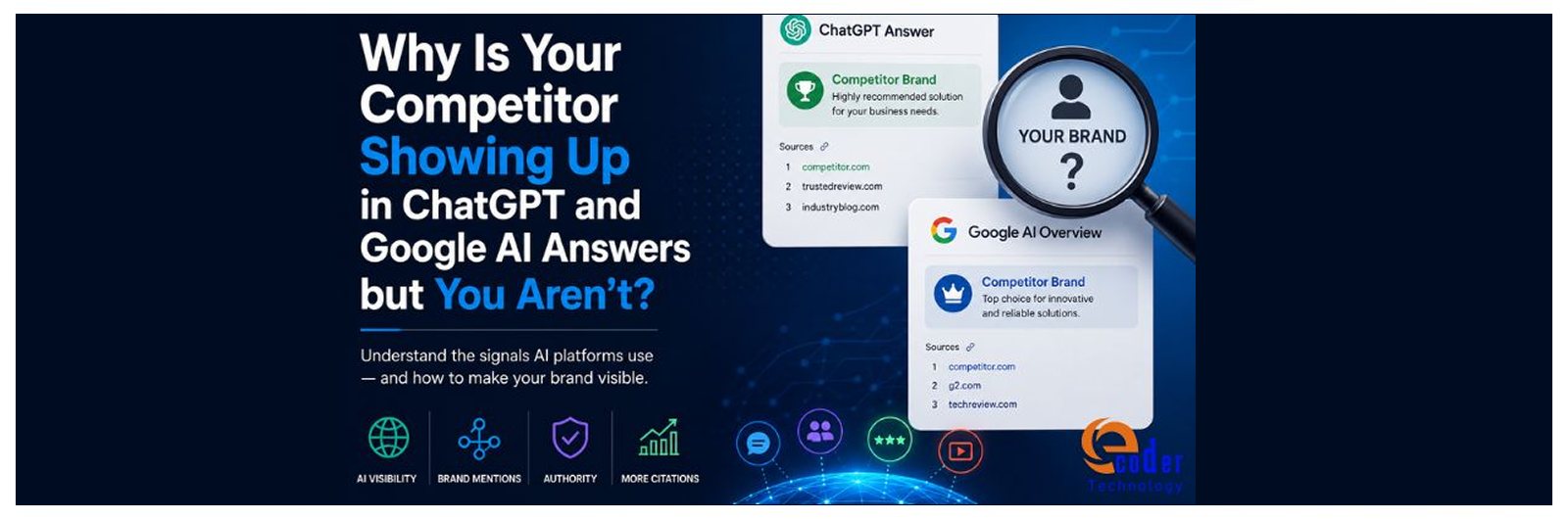
You’ve searched your category in ChatGPT and noticed your competitor’s name pop up while your own brand doesn’t even make an appearance. That’s not random. There’s a clear reason behind it, and once you understand how these systems work, you can start closing the gap.
Conductor’s AEO/GEO Benchmarks Report has analyzed over 13,770 domains across ten industries, covering 3.3 billion sessions and more than 100 million AI citations.
This landscape is real, it’s active, and your competitors are already making it work for them.
What Actually Happens When AI Answers a Question?
Platforms like ChatGPT, Google AI Overviews, and Perplexity don’t just toss out ten links. Instead, they pull information from a handful of trusted sources and stitch it into a single, blended answer.
In AI-driven search, there’s no “10 blue links” list anymore. You’re looking at one consolidated response, usually citing 3-8 sources. That means you’re either in that short list, or you’re effectively invisible.
Every query becomes a winner-takes-it-all situation, where the system is designed to favor the established players.
How Do AI Engines Choose What to Cite?
AI platforms rely heavily on Retrieval-Augmented Generation (RAG), which means they grab relevant content from the web or their training data and then generate a response based on that context.
For your content to show up inside an AI-generated answer, it has to clear three hurdles at the same time:
- It must be technically accessible to AI crawlers.
- It should be structured in a way that supports retrieval.
- It has to look authoritative enough that language models see it as a credible source.
Most websites stumble on at least one of these, which is why they’re routinely skipped over.
Why Is Your Competitor’s Site Showing Up and Yours Isn’t?
The answer lies in a handful of measurable signals that these systems respond to:
1. Domain Authority and Referring Domains
Sites with more than 32,000 referring domains are 3.5 times more likely to be cited by ChatGPT than those with up to 200 referring domains. If your competitor has built a strong backlink profile over time, they automatically get a boost in AI-driven results.
The top factors driving citations are:
- Domain authority
- High-quality backlinks from sites with DA 60+
- Mentions in “best of” listicles
- Total number of backlinks
- Unique referring domains
Strong signals like these are hard to fake, but very easy to engineer over time.
2. Brand Mentions across the Web
ChatGPT mentions brands roughly 3.2 times more often than it actually links to them. That means citations without a clickable URL still count for visibility. In other words, if you’re only chasing backlinks, you’re missing a big chunk of the opportunity.
Domains that show up frequently on platforms like Quora and Reddit are about four times more likely to be cited than those with little or no activity. If your competitor’s name keeps popping up in discussions, reviews, and comment threads, AI systems start treating them as the default answer to questions in your category.
3. Third-Party Review Profiles
Websites that maintain profiles on platforms like Trustpilot, G2, Capterra, and Yelp are three times more likely to be selected by ChatGPT as a source compared with sites that don’t show up there at all.
If your competitor is on G2 and you’re not, you’re handing them an easy advantage in AI-driven recommendations. Those profiles act as trust signals that language models tend to respect.
4. Content Structure and Format
AI systems don’t “read” your blog post the way a human does. They skim for extractable answers, which makes Q&A formats especially effective for AI search. Pages that use clear H2 and H3, bullet points, and short paragraphs tend to perform better than dense blocks of text.
If your competitor’s pages start each section with a direct answer, use FAQ schema, and organize content into digestible chunks, their posts are more likely to be picked up for AI answers, even if your writing is more polished or creative.
5. Content Freshness
Around 85% of AI Overview citations come from content published within the last two years, and about 44% are from 2025 content. AI platforms clearly favor recent, updated information.
If your competitor refreshes their key pages every quarter, while you haven’t touched yours since 2022, it explains why their brand keeps winning in AI-driven queries.
What Does Google AI Specifically Look For?
Google’s AI Overviews follow slightly different logic than ChatGPT because they’re tightly tied to traditional search rankings. Research shows that a page sitting at Position 1 has a 58% chance of being cited by ChatGPT; by position 10, that probability drops to 14%.
For Google AI Overviews in particular, if your website already ranks first in the organic SERP, there’s about a 33% chance it will also show up in AI Overviews.
Google AI Overviews tend to prioritize:
- Strong E-E-A-T signals (Experience, Expertise, Authoritativeness, Trustworthiness)
- Schema markup and structured data
- Content that already ranks in the organic top 10
- Clean, high-quality pages with authoritative citations
Domains that consistently appear in AI Overviews usually have solid page-level SEO fundamentals:
- clean technical signals,
- accurate schema, and
- well-organized content.
What Makes ChatGPT Recommend a Brand?
If you want your brand to start showing up regularly in ChatGPT-style responses, you need to align with how it weighs different signals.
List Placements
Placement in curated lists is one of the strongest drivers of AI recommendations. In contrast, traditional backlink campaigns that eat up a lot of budget often deliver surprisingly little in AI visibility.
Being featured in a “Top 10 [Your Category] Tools” article on a high-authority site can matter more for ChatGPT than months of classic SEO work. In an analysis of commercial recommendations, list mentions accounted for 41% of AI-driven recommendations, awards for 18%, and reviews for 16%.
YouTube Presence
There’s a fairly clear hierarchy:
- YouTube presence and brand mentions are the most important signals.
- Branded anchors and search volume come next.
- Traditional SEO metrics like backlinks and domain authority matter less.
OpenAI trained GPT-4 on more than a million hours of YouTube transcriptions. Brands with consistent, in-depth YouTube content are effectively “in the training data,” which gives them a long-term advantage that’s hard to replicate with website-only SEO.
Wikipedia and Reference Pages
Wikipedia accounts for nearly 48% of ChatGPT’s top-cited sources when it’s delivering factual answers.
Having a verified Wikipedia entry, or a well-maintained Crunchbase profile, signals to AI systems that your brand is a real, credible entity not just another website.
How Do You Fix Your Website?
If you want to actually move the needle on AI citations, here’s a practical, step-by-step plan.
1. Audit Your Current AI Visibility
Before you touch anything, take stock of where you stand today:
- Open ChatGPT, Google’s AI search, and Perplexity.
- Type in the kinds of queries your real customers would use.
- Take notes on which brands appear and which sources they cite.
This baseline will help you track progress and justify future investments.
2. Build Your Third-Party Presence
Focus your efforts on platforms that actually drive AI-visibility:
- G2/Capterra offers 3 times higher ChatGPT citation rates
- Reddit/Quora posts give brands 4x citation advantage with active mentions
- Wikipedia/Crunchbase act as foundational entity signals
- YouTube shows the strongest AI correlation signal across platforms
- Trustpilot/Yelp reviews act as trust signals for AI crawlers
Picking up a presence here is often more impactful than another round of on-page tweaks.
3. Restructure Your Content for AI Extraction
Every key page on your site should follow this updated structure:
- A 40-50 word paragraph that directly answers the main question the page targets. Think of this as a short answer capsule.
- Proper schema for FAQ sections, using schema.org markup.
- H2 and H3 sections that break content into scannable chunks.
- Original data, case studies, or unique insights that make your content stand out.
A multi-domain study revealed that more than 72% of pages cited by ChatGPT included a clear answer capsule. More than 50% of those also had original data or branded insights.
4. Earn Mentions in “Best Of” Roundups
Reach out to the authors of roundup articles in your niche. A single mention in a “Top 10 [Your Service] Companies” piece on a reputable publication can do more for your AI visibility than months of SEO.
Publishing content across a wider range of third-party sites, such as industry blogs, newsletters, trade publication, can increase AI citations by up to 325% compared posting only on your own domain.
5. Check Your Technical Accessibility
In 2024, Cloudflare changed its default settings to block AI-specific crawlers. That means any site running on default Cloudflare settings may have accidentally blocked major AI platforms like ChatGPT, Google, and Perplexity from crawling its content.
Review your robots.txt file and make sure you’re not blocking agents like GPTBot, Google-Extended, or PerplexityBot.
Wrapping Up: What Should You Do Right Now?
If you’re serious about understanding why your competitor keeps showing up in AI answers while you’re being skipped, the next step is a focused audit of your AI visibility.
An experienced digital marketing team can:
- Review your current visibility across ChatGPT, Google AI Overviews, and Perplexity.
- Map your technical setup, third-party presence, and content structure against leading benchmarks.
- Provide a clear, prioritized action plan that’s tailored to your specific category and constraints.
Ready to Make Your Site AI-Visible?
The sooner you start aligning your strategy with how AI systems actually work, the faster you’ll turn invisible into indispensable. Use our guide to create your strategy or consult AEO/GEO-experts today.
Frequently Asked Questions
How long does it take to start appearing in ChatGPT results?
Most brands that improve technical accessibility, build third-party mentions, and restructure content begin to see measurable changes in AI citations within about 60-90 days of consistent effort.
Do paid advertising on Google help with AI visibility?
Paid ads usually increase overall brand awareness and search volume, which leads to more brand mentions across the web. Those mentions are picked up by the AI systems.
Can a small business compete with larger brands in AI search?
ChatGPT correlates the least with traditional brand-dominance signals. That makes AI-driven search one of the most accessible channels for smaller brands that haven’t yet built massive domain authority or traffic.
Should I create separate content just for AI search?
You don’t need an entirely separate content strategy. Instead, adapt your existing content to be AI-extractable:
- Add clear answer capsules.
- Use proper heading hierarchies.
- Include schema markup.
- Inject original data or unique insights that AI models can reference.


