 +918918043592
 contact@ecodertechnology.com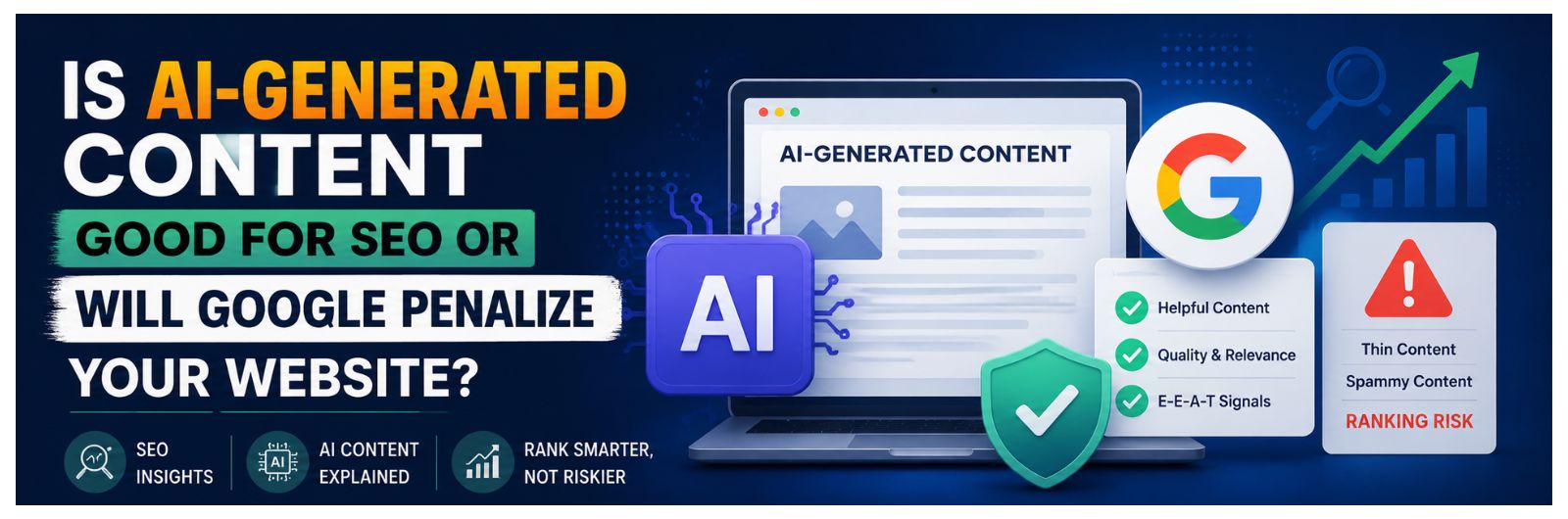
Simply answered, no content is ever penalized because you used AI to write it. However, your content will be penalized if it is unhelpful, thin, or mass-produced. This happens regardless of whether or not you used AI to produce content.
Everyone has an opinion on AI and whether or not it should be used to write web content. While some are overwhelmingly in favour of using AI, others are of the impression that having AI-written content will make their website rank lower on SERPs automatically.
Here are going to answer the question your marketing team is probably debating right now, making a deep dive into where AI content is useful and where it is not.
What Is Google’s Opinion on AI Content
Google has held a consistent position with regards to AI use since it released its March 2024 Helpful Content guidance update. The search engine does not penalize content because AI was used to generate it. It penalizes content that is low quality, unoriginal, or was simply created to manipulate rankings.
Google’s March 2026 Search Quality Rater Guidelines further iterates on this. Google’s human evaluators are instructed to assess content based on helpfulness, accuracy, and user satisfaction. It does not assess based on whether a machine was involved in writing it.
In fact, as of mid-2025, over 16% of Google’s top search results contain AI-generated content. These pages are ranking solely because they meet Google’s quality standards.
When Does Google Penalize Content
In early 2025, Google added a specific spam category called ‘scaled content abuse’. This checks behavioural patterns instead of tools used, and triggers penalties accordingly.
Thus, websites get penalized only in the following instances:
- Hundreds of template-like AI pages have been published but none of them contain original or helpful content.
- The published content fails to answer any of the queries raised by the user.
- The pages and their contents have been solely created with the intent of targeting long-tail keywords without any real value.
- The content lacks any verifiable author or editorial oversight.
- The content makes spammy, inaccurate claims without citing any verifiable sources.
Thus, if your website has vague content duplicated from other sources, none of it being original or particularly helpful to your target audience, your website is not going to rank. This is irrespective of how well you have done the SEO or designed the website.
Why the E-E-A-T Framework Matters More than Ever
Whether the content is human-written or AI-generated, Google evaluates its usefulness through the E-E-A-T framework. This makes it important for websites to understand the E-E-A-T framework if they wish to rank on SERPs.
| E-E-A-T Pillar | What It Means | How to Signal It |
| Experience | First-hand involvement with the topic | Case studies, real examples, personal insight |
| Expertise | Demonstrated knowledge in your field | Qualified authors, technical depth, citations |
| Authoritativeness | Recognition as a trusted source | Backlinks from credible domains, brand mentions |
| Trustworthiness | Reliable, accurate, transparent content | Named authors, HTTPS, clear sourcing |
As per Google’s September 2025 update to the Search Quality Rater Guidelines, Trust is the single most important pillar under the E-E-A-T framework. The reason is that the three other factors all trace back to it.
Thus, even if a website fares well on other signals but poorly on the “Trust” factor, it can still fail to rank on SERPs.
Where AI Content Fails and Why
In a 2025 audit of 500,000 AI-generated pages by Originality.ai, it was revealed that that approximately 31% showed thin-content signals. However, the issue was not that the content was AI-generated, but that the workflow stopped at the draft stage.
In essence, AI was used to write the first draft of the content and little to no edits was done before this draft was published. The resulting content was thin, loosely researched, and vaguely written with unverifiable references.
The most common ways AI-generated content fails are:
- Generic introductions that lack an original perspective.
- Use of unverified stats that cannot be traced back to their source.
- Lack of author information or credentials.
- Identical structure and phrasing across pages.
- Unedited, often identical, AI phrasing that occurs across the site.
- Paraphrased content where single piece of information is repeated across the content without adding anything new.
Had this draft been used as a barebones guide to what should be covered in your content and how the content should flow, with the writer adding genuine insights, experience, and original information, the same content would have performed well on SERPs.
Where and When Does AI Content Work Well
Should the fact that AI content stop companies from using AI completely? The answer is no.
AI, when used well, simplifies workflows, cuts down on research time, and helps sort through the thousands of sources of information available to find the most reliable, authentic sources. What it does not do is negate the need for original human input and perspective.
In essence, AI gives the raw structure and accessible data to work with. However, it is still up to the human, whether or not they want to present content that genuinely helps people or something replicated and available on 10 other sites, if not more.
While the first fares well on SERPs, the second does not.
AI works wonders in the following workflow:
- Generating content outlines that identifies helpful and necessary subtopics.
- Adding your own data, client stories, experiences, and insights.
- Having a subject-matter expert review the draft, or acting like a subject-matter expert yourself, to verify every piece of information.
- Attaching a named author with verifiable bio and credentials. This author does not need to be a person but can even be an organization/institute.
- Adding internal links that redirect to the right pages, source citations that trace back to the original source for a particular data, and schema markup before publishing.
AI Content and AI Overviews: How These Work Together
Ranking in Google’s traditional blue-link results (on top of SERP) and being cited in the Google AI Overviews are not the same. However, two different goals have one overlapping requirement, which is E-E-A-T. However, to rank on AI Overviews, pages need to have an additional factor. The content must be structured for direct, concise answers.
And, this is not all. The content must also have the following:
- A direct answer within the introduction, i.e., the first 60-80 words.
- Proper FAQ schema markup to signal the question-and-answer structure followed.
- Strong trust signals that include named authors and source links
- An active voice and direct language that AI can interpret and extract.
Quick Comparison between AI Content Approaches and How They Work for SEO
The following table helps us understand this at a glance:
| Approach | SEO Risk | AI Overview Eligibility | Long-Term Viability |
| Unedited AI draft published as-is | High | Very Low | Poor |
| AI draft with light editing | Medium | Low | Uncertain |
| AI draft with expert editing and sourcing | Low | Medium | Strong |
| AI-assisted, human-led content with original data | Very Low | High | Excellent |
Wrapping Up: Taking the Smart Way Forward with AI Content
Google no longer penalizes AI content, just weak, thin, and low-authority content that does not score well on E-E-A-T. With AI-generated content ranking well on Google, it is important to learn how to make the most of AI-workflows.
Since, E-E-A-T signals determine whether your content ranks or not, it is important to pair AI content drafting workflow with human expertise and experience. Once you publish structured, well-cited content, your AI-assisted content will also rank on SERPs.
Ready to Make the Most of AI-assisted Workflows?
With AI and Google’s content guidelines evolving, it is important to take a closer look at your workflow. Streamline your processes by using AI for drafting and human expertise for creating truly useful content that satisfies E-E-A-T signals.
Frequently Asked Questions
Does Google have a tool to detect AI content?
Google has not confirmed any specific AI-detection tool embedded in its ranking algorithm. What its systems detect is content that looks template-like, thin, or manipulative and behaviours that often accompany unreviewed AI output but are not exclusive to it.
Can AI content outrank human-written content?
When AI-assisted content is well-researched, expertly edited, and properly structured, there is no inherent ranking disadvantage. The output quality is what Google evaluates, not the production method.
What is the safest way to use AI for SEO content in 2026?
Always treat AI as a research and drafting accelerator, not a replacement for editorial judgment. Build your workflow so that every published piece has a named author, verified data points, and a clear purpose that matches the user’s search intent.
Will this change as AI search evolves?
The answer is likely yes, but the direction of travel is clear. The content standards getting higher. Google’s trajectory since 2024 has consistently moved toward rewarding genuine expertise and penalising volume-over-quality strategies.


