 +918918043592
 contact@ecodertechnology.com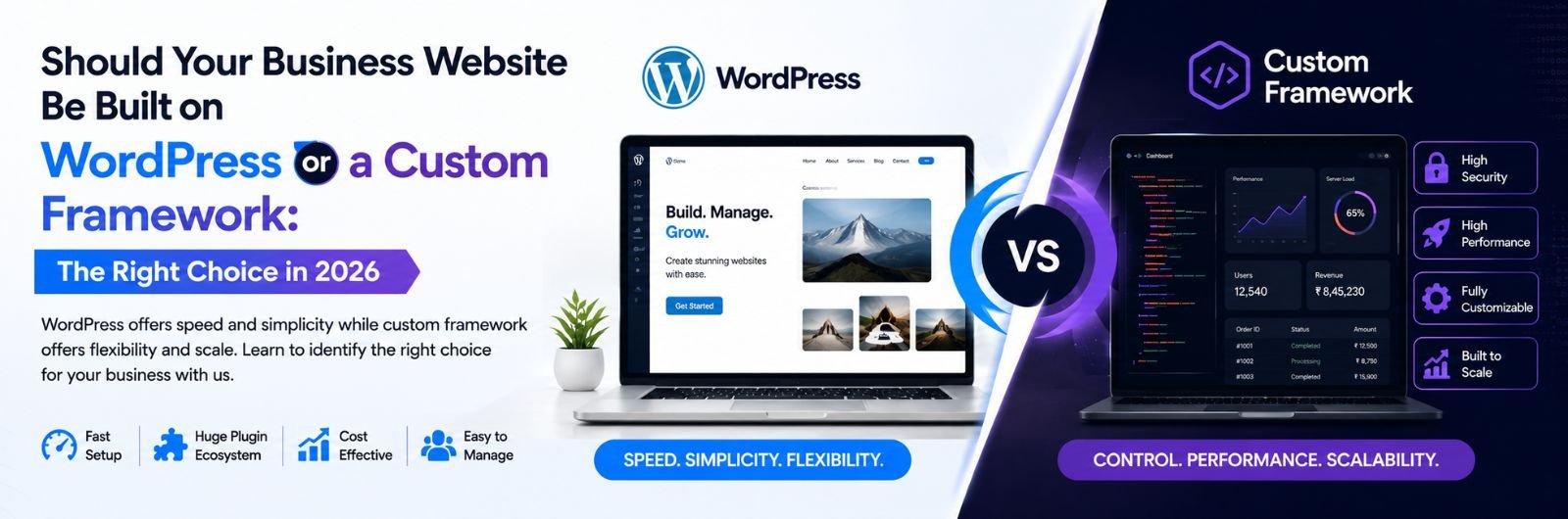
WordPress builds professional online presence fast and within budget. However, being an off-the-shelf tool, it limits workflows and scalability. When your business has highly specific needs, demands extensive scalability, and calls for certain security measures, a custom framework is the better choice. Thus, the answer depends entirely on what your website needs to achieve.
Almost half the websites on the internet use WordPress. This is a direct reflection of how flexible and easy-to-use WordPress. It is also why people treat it as the smart choice. However, this does not always mean that WordPress is the right choice for your business.
The decision between a custom site and WordPress has long-term consequences for your performance, security, scalability, and the cost of every future change.
The Reality of WordPress in 2026
As of April 2025, WordPress powers 43.4% of all websites available on the internet. Among websites using any CMS at all, WordPress commands 59-62% of the market. This makes it the most popular CMS globally. At 4.8%, Shopify is the next most popular CMS.
India and the USA each generate approximately 246,000 monthly searches for ‘WordPress’. In fact, India accounts for 8.05% of global WordPress website traffic.
Why WordPress Works Well for Businesses
WordPress does not have any licensing cost. You only have to pay for the domain and the hosting. It supports close to 60,000 free plugins covering almost every business requirement. It also offers more than 13000 free themes, while premium ones costs around $59.
WordPress is SEO compatible from the get-go, with built-in SEO capabilities through plugins like Yoast. Its ecommerce extension, WooCommerce, powers 38.74% of online stores across the globe.
Where Does WordPress Fall Short
Several of WordPress’ features come from plugins. Without regular optimisation, proper hosting, and updates, plugin-heavy sites become slow. 92% of security breaches on WordPress stem from outdated plugins and themes. This makes regular updates to core, plugins, and themes non-negotiable.
Unless there is adequate infrastructure investment, standard versions of WordPress struggles with high traffic volumes. Further, certain highly specific business need require workarounds instead of a single, clean build.
What is a Custom Framework Website?
A custom framework website is built using a programming framework chosen specifically based on what the project needs. The most common frameworks used include Laravel (PHP), React.js, Next.js, Vue.js, and Django.
Rather than adapting a pre-built CMS to your needs, a custom build creates exactly what your business needs. However, this does not make custom websites inherently better than WordPress.
They are simply a different tool, offering more control, more responsibility, and a higher upfront investment.
When is Opting for a Custom Framework the Right Choice
Custom frameworks are often the better and smarter choice in the following instances:
- The website needs to navigate complex and highly specific business needs that WordPress plugins cannot replicate properly.
- You are building a web application (dashboard, booking systems, and web portals) and not a content site.
- The security requirements are more than that is offered by a standard CMS environment.
- High web traffic is expected which requires extensive control over the website’s performance and infrastructure.
- You have dedicated developers on your team who will own the codebase long-term.
Comparing WordPress to Custom Framework
A direct comparison of WordPress to a custom-built framework is as follows:
| Factor | WordPress | Custom Framework |
| Time to launch | Faster; often days to weeks | Slower; often weeks to months |
| Upfront cost | Lower | Higher |
| Ongoing maintenance | Regular updates for plugins, themes, and core website | In-house developer or agency required for pushing updates |
| Security | Vulnerable to plugin exploits, but manageable | More controlled and secure (but varies with design) |
| Performance | Good with optimisation; limited by hosting and plugins | Excellent; built custom to your business requirements |
| Scalability | Requires infrastructure upgrades at higher traffic | Built to scale from the start if architected well |
| SEO Readiness | Strong built-in tools (like Yoast and RankMath) | Requires custom implementation of SEO best practices |
| Non-Technical Management | Easy; content teams can manage without developers | Generally requires developer involvement for changes |
| Customisation Ceiling | High, with plugin ecosystem; but workarounds common | Unlimited; if you can specify it, it can be built |
Choosing the Right Framework by Business Type
Not every business needs a custom-built website. However, for some, it is essential. Based on the type of business you operate, here’s what you need:
| Business Type | Recommended Choice | Reasoning |
| Local service business | WordPress | Fast, affordable, self-manageable; plugins cover all needs |
| E-commerce with standard catalogue | WordPress + WooCommerce | WooCommerce handles most requirements; 38.74% of online stores use it |
| E-commerce with complex pricing/custom logic | Custom framework | Rule-based pricing, multi-vendor, or subscription logic needs custom build |
| Corporate branding / portfolio site | WordPress | Rich theme ecosystem; easy for non-technical teams to maintain |
| SaaS product or web application | Custom framework | Applications need specific architecture WordPress cannot cleanly provide |
| School / institution / NGO | WordPress | Budget-friendly; extensive education and event plugins available |
| Booking / appointment system | Custom or WordPress hybrid | Depends on complexity; advanced booking logic often benefits from custom build |
| High-traffic media or news site | Custom framework or enterprise WordPress | Standard shared WordPress hosting cannot handle very high concurrent traffic |
Five Questions to Ask Before Deciding Between the Two
To understand which option suits your business better, here are five questions:
- Will I need my content team to update content without a developer present?
- Does my website require functionality that goes beyond standard WordPress plugins?
- Is the site being built for a specific web application or a general content site?
- What is my maintenance capacity?
- How much web traffic is expected and will shared hosting be able to support it?
If the answers point to simple and standard features, the WordPress is the right choice. If the answers point to specific logic, scale, or security requirement, the going for a custom built website is the better option.
Wrapping Up: Your Budget versus Your Platform
WordPress usually involves lower upfront investment, whether outsourced or done in-house. However, it involves regular cost of upkeep with plugin updates, backups, and security monitoring.
Custom sites involve high upfront costs, varying with functionality, API integrations, or large-scale systems. Here, maintenance costs depend on how frequently the codebase is updated.
With either system, choosing wrong involves significant costs of overhaul and lost business. Thus, the choice is not one of budget, but requirement which needs to be evaluated carefully. Most Indian SMEs are well served by WordPress; custom builds become relevant as complexity, traffic, or data requirements grow.
Ready to Deploy Your Website?
Evaluate your business needs and consult experts who build both WordPress and custom web applications from scratch for businesses.
Frequently Asked Questions
Can I migrate from WordPress to a custom framework later?
Content, images, and data can be transferred, but the site architecture will need to be rebuilt from scratch. Plus, migration also involves certain costs. Thus, it is best to choose well from the get-go.
Is WordPress secure enough for handling customer data?
WordPress can be made secure through HTTPS, reputable plugins only, regular updates, strong credentials, and a good security plugin. The vulnerability risk comes primarily from outdated plugins and themes. For sensitive financial, health, or legal data, a properly configured WordPress setup with dedicated hosting and active security monitoring.
What is the best WordPress hosting for Indian websites in 2025?
Hostinger, SiteGround, and WP Engine are among the reputable options that offer Indian-region servers. Shared hosting is fine for low-traffic sites; move to VPS or managed WordPress hosting for high monthly traffic.
Can I use a website builder like Wix?
Building on WordPress gives you far more control, customisation, and long-term flexibility than a platform like Wix. Builder platforms lock your website into their ecosystem. As a result, migrating later turns into a complete overhaul.


