 +918918043592
 contact@ecodertechnology.com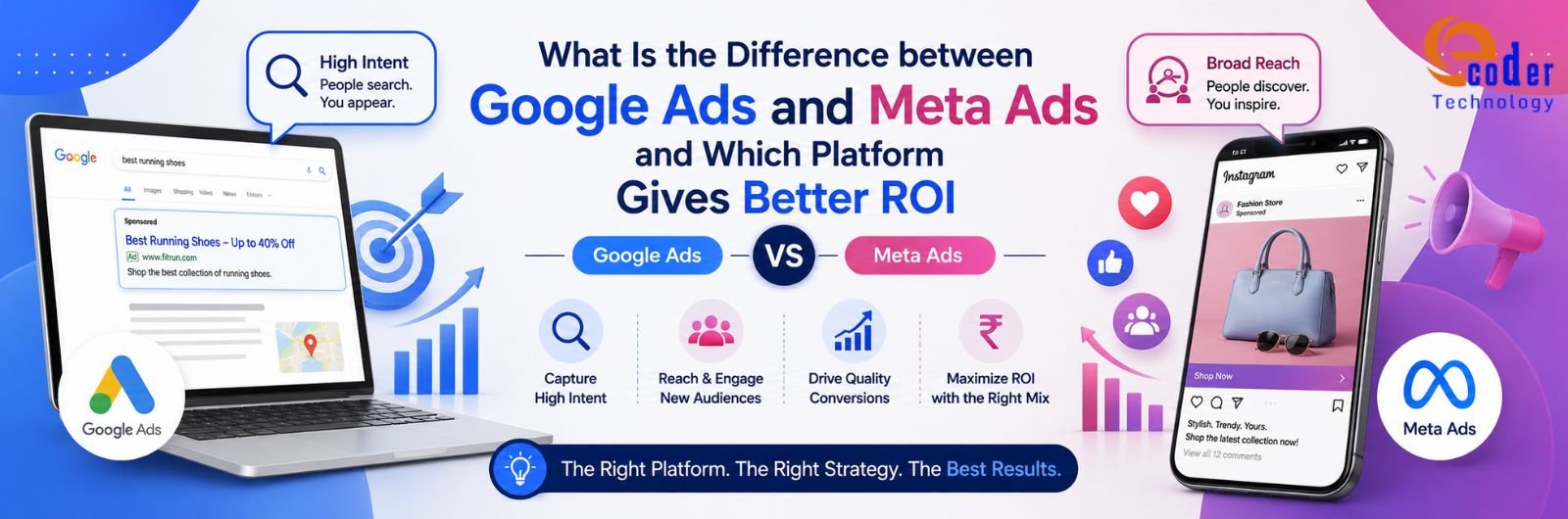
Google Ads target people who are already searching for products/services similar to what you offer, serving as costly but high-intent tools. Meta Ads come with a broader reach, showing your products/services to people who might be interested. While Meta Ads have a lower cost per click, their broad nature calls for better fine tuning and lead nurturing.
Every business, when they plan to run ads, ask the same question, “Google or Meta?” The two platforms differ in terms of how they find the target audience, what you pay, what you can show, and what happens when people click the ad.
We are going to break down how both platforms work, giving you a practical guide on how to make the most of both.
How India’s Paid Ads Landscape is Distributed
In 2025, India had a digital marketing landscape worth $13.22 billion, projected to reach $14.56 billion by 2026. Within this, Google and Meta together held 64% of all ad revenues.
In India, social media (led by Meta) accounts for 23% of total digital ad spend, while search advertising (prominently on Google) accounts for 18%. This gap is a direct reflection of audience behaviour, where people scroll Instagram before they become aware of a product and search on Google.
Also, 92% of Meta’s advertiser base in India consists of small and medium enterprises, making it the go-to platform for SMBs.
What is Google Ads and How Does It Work
Google Ads is an intent-based advertising platform. If a user types a query in Google Search, the ad will appear alongside organic results. The advertiser pays if the user clicks on the ad.
Since it is intent-based, the ads are shown only to users who are looking for something similar. Thus, leads are delivered faster.
Google Ads can target:
- Keywords typed into Google Search
- Device location (city, region, radius around a pin)
- Device type, time of day, and day of week
- Audience segments (based on browsing history and purchase signals)
- Remarketing (based on previous visitors to the site)
Plus, it is available in the following formats:
- Search Ads: Text results on SERPs
- Display Ads: Image ads across websites
- Shopping Ads: Product image and price in search results
- Video Ads: In-stream and pre-roll ads on YouTube
- Performance Max: AI-driven campaigns across Google’s platforms
What Are Meta Ads and How Do They Work
Meta Ads run across social media platforms, i.e., Facebook, WhatsApp, Instagram, and Messenger. Here, the ads show up while the user scrolls. So they need to be relevant, well-timed, and compelling enough for the user to stop scrolling.
Meta follows an interest and behaviour-based targeting model to determine the target audience. Thus, people who have liked, shared, commented on, and/or purchased something similar will see the ad.
Meta Ads target:
- Demographics (age, gender, location, language)
- Interests (pages liked, content engaged with, hobbies)
- Behaviours (purchase behaviour, device usage, travel habits)
- Lookalike Audiences (people similar to your existing customers)
- Custom Audiences (your own customer list or website visitor)
The ad formats that you can use include:
- Image and video ads: shown in Feed, Stories, and Reels
- Carousel ads: multiple images or products in a single swipeable unit
- Collection ads: product catalogue with instant shopping experience
- WhatsApp click-to-chat ads: sends users directly into a WhatsApp conversation
- Lead generation ads: captures contact details without leaving the app
How do Google Ads and Meta Ads Compare against Each Other
A side-by-side comparison of Google and Meta Ads is as follows:
| Factor | Google Ads | Meta Ads |
| User intent | High; user is actively searching | Low to medium; user is browsing passively |
| Targeting method | Keyword + audience + intent signals | Demographics, interests, behaviours, lookalikes |
| Average CPC (global) | ~$5.26 across all industries (search) | Lower CPC; varies by audience and creative |
| Avg. conversion rate | 7.52% across all industries (2025) | Typically lower; depends heavily on creative and funnel |
| Best for | Capturing existing demand | Creating and nurturing new demand |
| Creative requirement | Strong copy; visuals are less critical | High-quality visuals/video is essential |
| Lead speed | Faster; intent is immediate | Slower; requires nurturing post-click |
| Brand awareness | Limited on search; strong on Display/YouTube | Excellent; reach and frequency at low CPM |
Table 1: Comparison between Google and Meta Ads.
ROI and Performance Benchmarks of Google and Meta Ads
At a glance, a comparison of the ROI and performance for both is as follows:
| Metric | Google Ads (2025) | Meta Ads (2025) |
| Average conversion rate | 7.52% (all industries) | Varies; typically 2-5% for most sectors |
| Average CPC (search) | ~$5.26 globally; lower in India | Lower CPC; stronger on reach than intent |
| Average ROAS (all sectors) | 2:1 baseline; higher with optimisation | 6:1 in e-commerce with strong creative |
| Lead conversion speed | Faster; days to close | Slower; typically 2-4 weeks nurturing |
| Brand recall lift | Moderate | High; especially on video and Reels |
Table 2: Performance Metrics of Google and Meta Ads.
WordStream’s Benchmark study placed Google’s conversion rate at 7.52% across industries, showing a 6.84% improvement, in spite of a 12.88% rise in average CPC. This makes Google a high-cost, high-conversion tool.
Meta has lower per-click cost, but lower purchase intent per click. However, it serves as an effective retargeting and awareness-building tool.
Which Platform Works Best as per Business Type
The choice of ad platform must be made based on the business type. Here’s what we recommend:
| Business Type | Recommended Platform | Why |
| Local service business | Google Ads | Users search ‘near me’ with high intent to book immediately |
| E-commerce / D2C brand | Meta first, Google for remarketing | Visual products need desire-building; search recaptures cart abandoners |
| B2B / professional services | Google Ads | Decision-makers search with specific intent; high conversion value justifies CPC |
| SaaS / app product | Meta for awareness, Google for branded search | Broad awareness + capturing users already researching your category |
| Education / EdTech | Both | Meta builds aspiration; Google captures active course-seekers |
| Real estate | Google Ads | High-intent search (‘2BHK Pune under 60 lakh’) converts far better than social browse |
| Fashion / lifestyle brand | Meta (Instagram/Reels) | Visually driven, impulse-purchase behaviour; Meta’s format is the product |
| Restaurant / food delivery | Meta + Google Display | Location-based awareness on Meta; search for branded queries on Google |
Table 3: Choosing platforms based on industry.
Strategically, you can opt for the following split for your business:
| Business Stage | Recommended Split | Rationale |
| Brand new, building awareness | 70% Meta / 30% Google | Need reach and recognition before search intent exists |
| Established, optimising conversions | 40% Meta / 60% Google | Demand exists; prioritise intent capture over awareness |
| E-commerce with a product catalogue | 50% Meta / 50% Google | Meta drives discovery; Google Shopping closes the sale |
| Local service with no brand presence | 80% Google / 20% Meta | Intent-based search converts faster for service businesses |
Table 4: How to split your ad spend.
Wrapping Up: Opting for One or More Ad Platforms
30% of Indian marketers choose their advertising platform based on familiarity and bias rather than campaign data. However, this can turn into an expensive mistake. While Meta builds awareness, Google captures intent. And, this should be the foundation of your ad campaign.
Sequence your ad campaign properly, using Meta to create awareness and Google to capture high-intent audience. Similarly, retarget Google’s non-converters to Meta for generating interest. Track your campaign metrics, set your daily limits, and monitor pacing week for an effective campaign.
Ready to Start Your Ad Campaign?
Use this guide to plan your campaign or reach out to experts who handle everything from strategy and setup through to on-going optimisation and reporting.
Frequently Asked Questions
Should SMBs use Performance Max?
Performance Max can be effective for e-commerce with a product feed, but requires careful asset input (multiple images, videos, headlines) and strong first-party audience signals to perform well. Without sufficient conversion data, Performance Max can underperform.
How does WhatsApp advertising fit into a Meta Ads strategy?
WhatsApp click-to-chat ads are one of the highest-performing ad formats for Indian businesses. They appear on Facebook and Instagram but send the user directly into a WhatsApp conversation with your business when clicked.
How long does it typically take to see results from each platform?
Google Ads can produce leads within days if search demand for your keyword exists and your landing page is ready. However, Smart Bidding strategies need 2-4 weeks of data to optimise properly. Meta Ads require 1-3 weeks for the algorithm to deliver. The first 30 days on either platform should be treated as a data-gathering and calibration period.
How do I set up conversion tracking properly for Google Ads?
Conversion tracking requires installing the Google Ads tag on your website and defining a conversion action. The most reliable method is through Google Tag Manager, which lets you deploy tracking without editing your site’s code directly.


