 +918918043592
 contact@ecodertechnology.com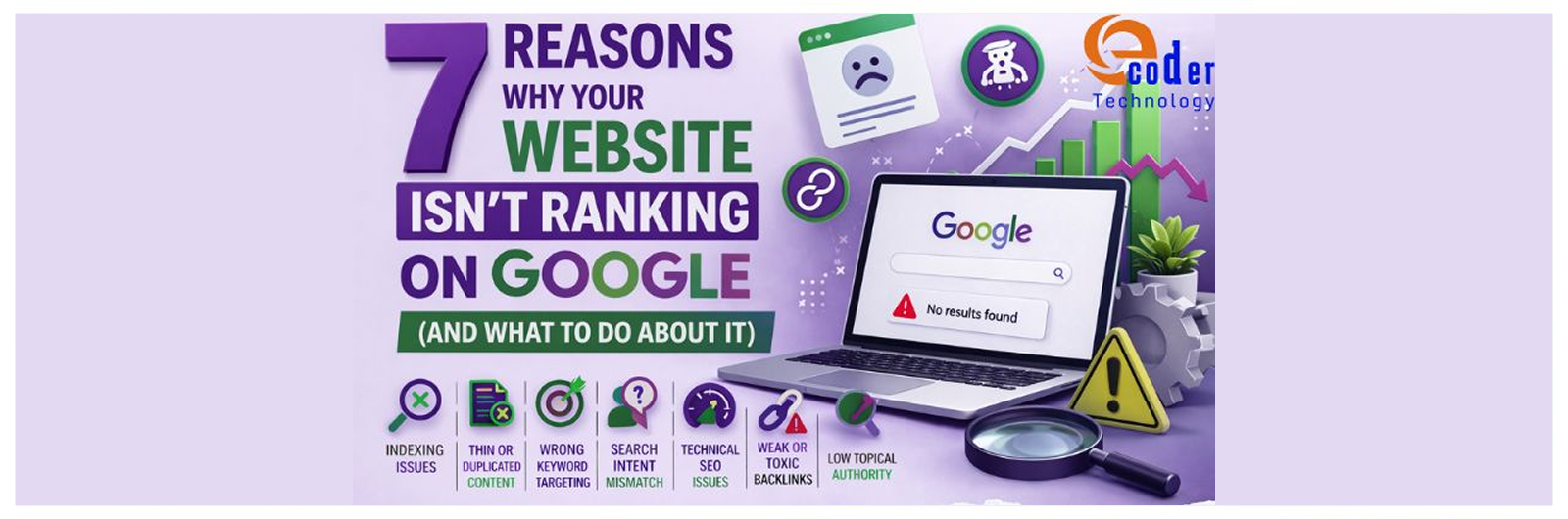
According to Ahref’s 2024 SEO statistics roundup there is a glaring disparity:
- 96.55% of all pages available on the Internet do not get any traffic from Google.
- Only 1.94% of pages receive one to ten visits in a month.
- 49% of the total search traffic goes only to the top ranking page.
The problem is rarely just one mistake. It is usually a mix of weak content, technical gaps, and poor authority. Often, a site does not rank due to indexing problems, thin content, weak keyword targeting, poor search‑intent match, technical issues, a weak link profile, or low topical authority.
With Google driving 93% of the total web traffic, ranking on Google is key. Let’s take a deep dive into the most common issues and how you can fix them.
1. Google isn’t Indexing Your Pages
Ask yourself this “Can Google rank my site if it cannot see it?”
Many sites that have no traffic have most pages excluded from search. A common sign is adding or editing content that never appears in Google, even after repeated crawls.
To identify this, here are some key checks that you can try:
- Go to “Google Search Console” and verify that your homepage and key pages are indexed.
- Check whether ‘no index’ tags, ‘robots.txt’ blocks, or canonical issues are hiding the pages.
- Make sure that you have submitted the correct sitemap which contains the crawled URLs that you care about.
If you find any issues, here’s how you can fix them:
- Remove blocking directives from pages you want ranked.
- Fix crawlable links to them.
- Submit updated URLs in Search Console.
2. The Content is Thin, Generic, or Duplicated
If your pages have barely a few lines of content, something generic, or heavily duplicated content, there is little to no chance of your website ranking. Google’s 2024-plus updates place a lot of weight depth, originality, and real-world value.
The biggest signs of thin content include:
- Short product or service pages that have repetitive and basic descriptions.
- Blog posts that summarise without adding actual value or unique insights.
- Multiple pages containing nearly identical meta titles and H1s.
To fix this, your first task should be to rewrite underperforming pages. These pages should be useful in answering at least three follow-up questions that a visitor might ask. You can also add checklists, steps, or examples they can actually use.
3. Your Page is Targeting the Wrong Keywords
A common problem among sites is that some rank for “brand + location” but not for the core service terms they actually want. Another very common problem is that certain sites chase broad and highly competitive phrases while ignoring long-tail queries that convert better and are easier to rank for.
The biggest and most common keyword mistakes that sites make include:
- Targeting broad keywords as a smaller site.
- Going for phrases that your audience is not going to search for (usually keywords that feel right but lack volume).
- Not accounting for commercial intent and only going for informational keywords.
The way ahead is going for a mix of seed tools and Google Suggestions to identify 3 to 5 commercially relevant keyword clusters per landing page. Then, follow up by using these keywords as the basis for fresh content.
4. Mismatch between Search Intent and the Pages
Let’s assume your page is technically perfect. It can and will still fail if it doesn’t deliver what people want. For example, “how to fix tyre puncture” needs a step-by-step guide, not a brand brochure.
Let’s take a look at how intent breaks rankings:
- Informational query pages that are full of sales copy.
- “Best X” style pages not having any product comparisons or pros-and-cons list.
- Service pages that don’t outline the pricing structure, process, or outcomes.
If this is what your site is facing, you can resolve it fairly easily. For each target keyword, open the top 3 SERP pages and make a note of the following:
- Are they lists, how‑tos, or product reviews?
- Do they lead with price, examples, or FAQs?
Based on this information, restructure your page to match that intent much more closely.
5. Technical SEO Acting Like a Roadblock
Even when the content and site is working fine, slow speed, broken links, and mobile issues can cap rankings. According to Google’s 2024-plus signals, performance and UX are no longer just nice-to-haves but key ranking signals.
In fact, SISTRIX’s 2024 Index Watch report stated that even large domains lost approximately 72-98% of their organic visibility.
Top technical issues that a site can face include:
- More than 2-3 seconds of page load time when accessed on a mobile.
- Mobile layouts that zoom or pinch, especially with buttons that are out of alignment.
- Presence of mixed HTTPS/HTTP, broken links, or 4xx errors on key pages.
The steps to resolve these are fairly straight-forward:
- First, run a core-web-vitals audit in Search Console and PageSpeed Insights.
- Then, fix the bigger factors defer non-critical JS, compress images, and remove render‑blocking resources.
- Finally, run a crawl check to patch 404s and clean up the redirects.
6. Weak or Toxic Backlink Profile
As a new or fresh site, your platform might not have the backlink authority needed to rank for meaningful terms. Plus, the presence of spammy or irrelevant links can and will drag your rankings down.
Here’s how a strong backlink profile will look like
- References from relevant industry blogs, local directories, or news mentions.
- Links pointing to specific, useful pages (not just the homepage).
- No sudden spikes of low‑quality directory or PBN links.
To achieve this, here’s what you need to do:
- Disavow the links which come off as spam using Search Console, wherever appropriate.
- Build 5-15 high-quality links per quarter through guest posts, case studies, or local PR, which focus on your main service pages.
7. A Lack of Clear Topical Authority
Google now rewards sites that clearly own a niche or vertical, not generic players. If there are multiple pages with loosely scattered themes on your site, algorithms struggle to trust your site for any single topic.
Signs that indicate weak authority include:
- Absence of a clear core service (e.g., one “SEO” page and five unrelated blogs).
- Lack of recurring and accurate content focused on your main audience or use cases.
- Presence of competitors who rank for multiple related terms; while you float in and out of results.
To fix this, here is what you need to do:
- Design a logical content cluster. This will include one pillar page for your main service and another 5-10 supporting subtopic pages that speak to your expertise and authority on the matter.
- Then, link those pages together. Be sure to cross-reference real-world examples.
- Also, update your content periodically (preferably quarterly) to keep it relevant.
The Quick Fix Checklist by Priority
Simply knowing the shortcomings of your site and how to resolve them is not enough. The fix works best when you know how to prioritise the tasks like a pro.To enjoy the best possible outcome, this should be the order of your tasks:
- Indexing and Crawl
- Get confirmation that all the important pages are indexed.
- Then unblock the ‘noindex’/ ‘robots.txt’.
- Major Technical Issues
- Fix the site speed, mobile responsiveness, HTTPS, and 404s for core pages.
- Address Content and Intent
- Rewrite pages with thin content to answer relevant questions.
- Match SERP intent for each target keyword.
- Links and Authority
- Clean up the toxic links present and build a small but relevant profile.
- Build Topical Authority
- Find topics that are at the core of your product/service.
- Build content around them to attest to your authority.
Once this is sorted, give your site some time. SEO works organically, not instantaneously. Over the span of a few weeks, you will be able to see the improvement for yourself.
Wrapping Up
If your website isn’t ranking, chances are one (or more) of these seven issues is the reason why your website is not visible.
The fastest way forward is to first audit indexing and tech. Then, sharpen your content and keyword strategy to make it impactful. Finally, grow real-world authority through clean links and focused topics.
Ready to Make Your Site Rank on SERPs?
Start with a single high-value landing page, apply this sequence, and then repeat across the rest of the site. Alternatively, seek expert assistance from SEO consultants who know how to make sites rank in our niche.
Frequently Asked Questions
How long do I need to wait before a new page ranks on Google?
Most new pages take weeks to months to gain traction, especially in competitive niches. If a page has no traffic after 3-6 months despite solid content and indexing, it likely needs better keyword targeting or stronger internal links.
Should I rewrite every page on my site at once?
No. First, focus on 5-10 high-value pages that drive or could drive the most traffic and conversions. Then, optimise those pages and monitor their performance. Once, you see that this strategy is working for you, expand the effort.
Are meta tags still important for ranking?
Of course, but they’re a secondary signal. Clear, click-driven titles and concise descriptions help CTR and user intent, which supports rankings. However, it is best to avoid stuffing and instead mirror the main keyword and intent.
Can a site rank even if it has low domain authority?
A site with low domain authority can still rank for long-tail or niche keywords where competition is smaller and intent is very specific. Having strong page-level content, clean technical SEO, and a few relevant links can move smaller sites into the top 10.


