 +918918043592
 contact@ecodertechnology.com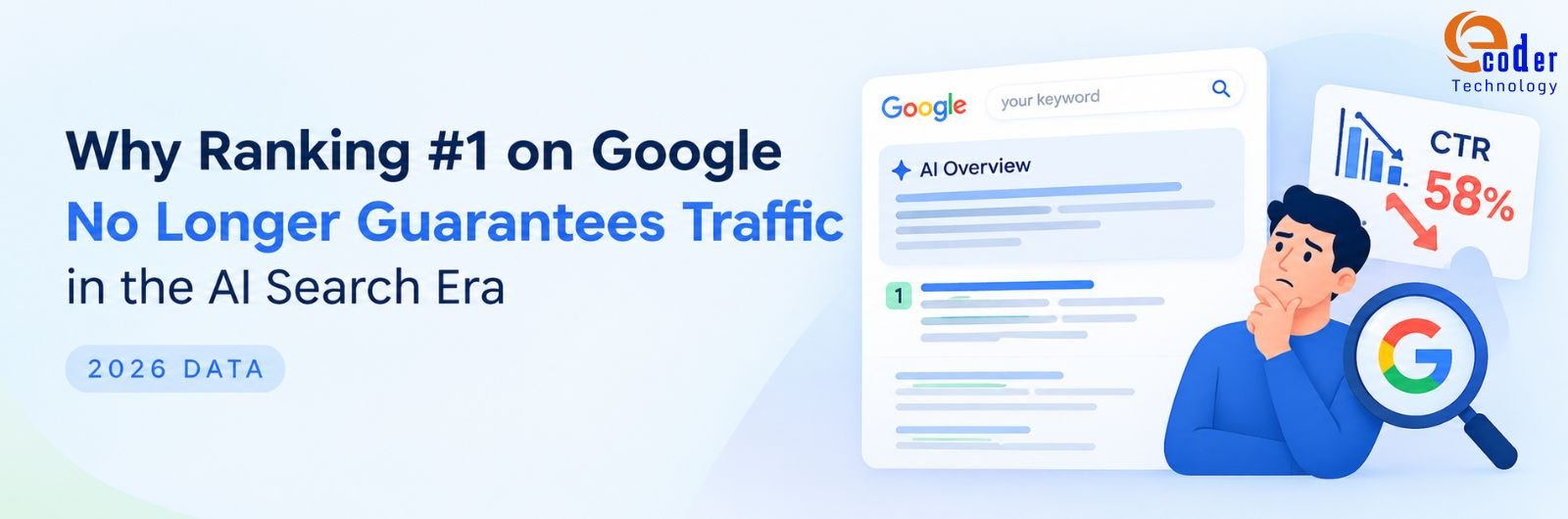
With extensive content and technical optimisation, a business can hold the top organic position on Google. However, this does not always guarantee traffic. Even a website that hold top organic ranking for its most valuable keyword can still watch traffic decline month over month.
This gap between ranking on SERPs and actually gaining traffic confuses a lot of business owners who did everything their SEO team asked. The answer to this challenge does not involve the ranking mechanism at all. Instead, it has much to do with the way the SERP is presented and what the user sees before reaching the website’s link.
Throughout 2025 and well into 2026, SERPs are changing in a manner traditional dashboards are unable to track.
How Much Has the CTR (Click-Through Rate) for Top Ranking Pages Fallen
In December 2025, Ahrefs analysed 3,00,000 keywords and found out that when AI Overview results appear on top of organic search results, the CTR for the top-ranking page decreases by 58%. This showed a sharp decline from the 34.5% which was measured in April 2025.
Additionally, position-one click-through rate for keywords that trigger an AI overview fell from 0.073% in December 2023 to 0.016% in December 2025. That means a page holding the top spot for a query with an AI Overview now gets roughly two clicks for every ten thousand people who see it, down from about seven.
This is not a one-time fluctuation in user behaviour but a trend that was identified over two years of data.
How Often Do Searches End Without Any Clicks At All
Pew Research Center tracked actual browsing activity from 900 U.S. adults across roughly 69,000 real Google searches in March 2025. Users clicked through to the organic result, which are placed below the AI Overview, in only 8% of searches where an AI Overview appeared. In searches that did not offer an AI Overview, this figure was 15%, which is nearly double.
This behaviour shows more than just users opting out of clicking a link. 26% of users end their after seeing the AI Overview, compared to 16% of sessions ending when there is no AI Overview. This happens because a fair number of users find what they are searching for in the AI Overview results and need not visit any website for clarification. This holds true for even for well-optimised pages since it is driven by the design of the SERP and not the website itself.
This reframes how a website needs to be optimised when the business is thinking in terms of SEO and SERP results.
What Should a Business Track Instead of the Top SERP Position
With SERPs being designed the way they are, AI Overview on top and organic results below it, ranking has turned into a different asset. Only 17% of AI Overview citations now come from pages ranking in the organic top 10, down sharply from 76% in mid-2024. This means organic search results and AI Overviews are no longer in the same competition.
At the same time, 94% of AI Overviews still cite at least one URL from the top 20 organic results. Usually, this count is a lot more. Thus, ranking is still just as important and the business/website in question still needs strong organic visibility. However, the assumption that just because a website is ranking that people will click no longer holds true.
In the current landscape, three metrics hold significant importance:
- Citation presence inside AI Overviews and chatbot answers has turned into a visibility metric, separate from the traditional rank tracker.
- Branded search volume and direct traffic matter because a shrinking share of new customers is discovering a business for the first time through an informational search that ends in a click.
- Assisted conversions, meaning the customers who saw a business mentioned or cited without clicking through, but converted later through a direct visit or a branded search are gaining traction over click-based analytics.
Does Ranking #1 on SERPs Still Matter
It does because the factors that make a page rank #1 on SERPs and appear in AI Overviews overlap. A page still generally needs strong organic relevance and structure to be eligible for an AI Overview citation in the first place, since 94% of citations still draw from the same top-20 pool that traditional rankings have always rewarded.
However the relationship between the rank and the outcome has changed. Ranking is no longer sufficient on its own. A page can now do everything right by traditional SEO standards, hold its position through multiple algorithm updates, and still see its click volume erode simply because the environment around that ranking has changed.
This is an important shift for a business investing in SEO and tracking the returns from said investment.
Which Type of Queries are the Most and Least Affected
In January 2025, 91.3% of queries that triggered an AI Overview were purely informational. By October 2025, that share had fallen to 57.1%, as commercial and transactional queries increasingly began triggering AI Overviews.
Searches where a user was trying to find a certain brand/page, i.e., a navigational search, saw an even sharper shift. AI Overview triggering on navigational queries jumped from 0.74% of searches in January to 10.33% by October. This shows that the shift is no longer confined to generic how-to and definition searches. Commercial research queries and even brand-name searches are increasingly part of the same pattern, making it relevant for top-of-the-funnel content.
How Does this Change Look on a Monthly Report
Let’s assume Website A has held the top organic spot for its main keyword for over a year, and the same is being shown by the rank tracker. When the keyword starts triggering AI Overview, traffic drawn and rank gained become two very different stories.
Impressions may hold steady or even grow, since the page is still being shown to searchers. Clicks decline irrespective of the rank held, because a shrinking share of those searchers ever scrolls past the AI-generated answer at the top of the page.
As a result, rank and CTR must be tracked separately instead of together.
What Does This Look Like for Indian Businesses
Though the study cited was conducted in the USA, the shift is not a US-only story. AI Overviews now appear in roughly 40% of Indian search queries. A study tracking Indian users across January and February 2026 found out that AI Overview reduced organic clicks by 38% on queries where they appeared. Also, outbound clicks per search rose from 0.38 to 0.61, showing people are interacting more with the AI than with the pages the AI is drawing from.
In addition to AI overview, there is now another layer to searches in India. According to OpenAI’s own data, ChatGPT now has 100 million active users in India. This does not just impact raw traffic volume. A local business competing with other local listings now has to compete with whatever source an LLM trusts for the given topic.
Which Query Types and Businesses are Insulated from This Shift
The impact of AI Overviews is disproportionately distributed. Ecommerce queries trigger AI Overviews only 2-4% of the time, and local service queries about 2-7%. When compared to informational queries which trigger AI Overviews almost always, the gap is significant.
Thus, businesses that are selling a particular product or a service available locally are seeing far less erosion in click volume compared to a website built around information.
Further, 40% of the sources that AI Overview cites from sit on the second page of Google’s organic results. This reinforces that fact that citations increasingly reward clear, well-structured answers over ranking position.
How Should a Business Adjust Its SEO Strategy
The best way forward is to widen the scope of what SEO is supposed to measure and deliver. Rank tracking will always indicate whether a page is eligible for citation, since the parameters remain the same. Alongside it, citation appearances inside AI Overviews and AI chatbot answers should be tracked separately, since the hold a significant share of SERP visibility.
SEO teams need to keep a closer watch on branded search volume and direct traffic since fewer users are discovering brands through an informational search. Content should be structured with clear, extractable answers and named expertise, since the same clarity and originality signals that earn a citation inside an AI Overview also tend to earn a stronger traditional ranking.
Websites should still treat top 20 organic placement as a goal and priority since most of the AI citations are drawn from here. However, this should be treated as the floor and not the entire task.
Are There Any Benefits to This Trend?
With CTRs decreasing, some are of the opinion that AI Overviews are decreasing the number of visitors that could have been converted to a customer for a given website. However, this is far from true.
AI Overview helps people get concise, usually accurate information about a given keyword or query. That does not stop people with a transactional intent. Further, it gives people the choice of multiple websites clickable through the citation links given on the right hand side.
The result is that a higher number of people visiting the website re coming in with a commercial intent and will turn into a paying customer given that their requirements are being met.
Wrapping Up
Businesses need not panic thinking that even if their ranking report is looking strong, there might be issues underneath. Instead, they should look at a second report that covers AI Overviews and citations. Businesses that make use of both will have a much clearer picture of what is actually driving growth than those still relying on rank position as the only signal.
Even if the ranking report for your business is looking strong, taking a closer look at all parameters might be worth the time. Consult SEO experts for an in-depth audit that covers AI Overviews, citations, ranking, CTR, and every parameter that LLMs and search engines both treat as trust signals.
Frequently Asked Question
Can a Business Opt Out of Having Its Content Appear in AI Overviews?
Technical controls exist to limit how content is used for generative summaries, but blocking them entirely also risks losing eligibility for citation, which is now a meaningful visibility channel itself.
Do AI Overview citations change over time for the same query?
Yes. Roughly 70% of pages cited in AI Overviews change within a 2 to 3 month period, and these shifts are not always linked to changes in traditional organic rankings.
Is Losing Traffic From AI Overviews the Same as Losing Rankings?
No. A page can hold its organic position while still losing clicks, since the click loss comes from users getting their answer directly on the results page, not from a ranking drop.
Are Paid Search Ads Affected by AI Overviews the Same Way Organic Results Are?
Paid click-through rates have also declined alongside organic CTR when AI Overviews appear, though ad placements within and around AI Overviews have expanded significantly since early 2025.


